


ARCHITECTURE
Intelligence evolves off-chain. Coordination is verifiable on-chain.
Flexible execution environments and substantial computation live off-chain. The chain holds commitments, statuses and, later, contribution accounting. It does not execute training and does not decide whether an improvement is valid.
LAYERS
Four layers, one boundary.

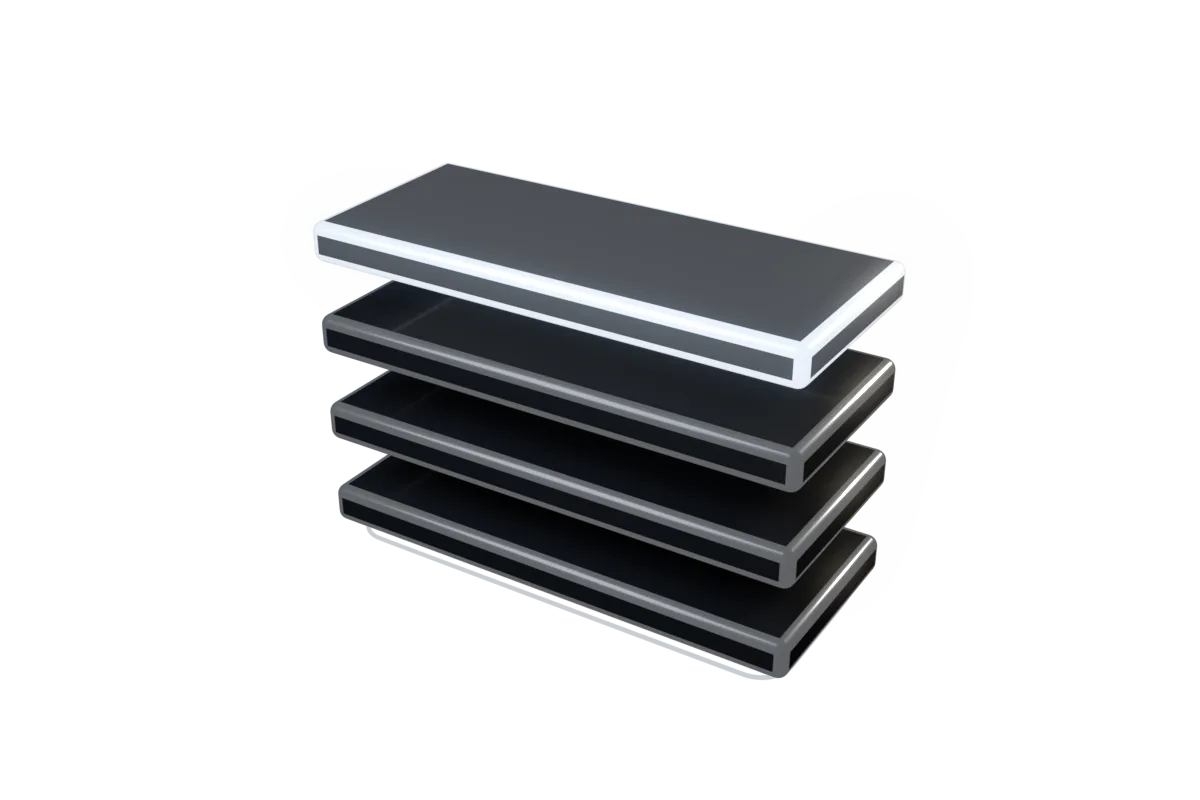



- 01
Intelligence layer
Candidate algorithms, model changes, research procedures, and experiments.
off-chain · flexible execution
- 02
Evaluation layer
Baselines, held-out tasks, independent replication, and result reporting.
off-chain · sandboxed · reproducible
- 03
Protocol layer
Improvement records, lineage, attribution, challenges, and incentive rules.
off-chain registry · on-chain commitments
- 04
Settlement layer
Production smart contracts on Robinhood Chain · 4663: commitments, challenge status and, later, contribution accounting.
on-chain · verifiable
TRUST BOUNDARIES
Untrusted code touches nothing it can keep.
Candidate code runs in a fresh microVM with network egress denied, communicates with the trusted harness only through a line protocol, and is discarded when the run ends. Scoring happens outside the solver process.
COMPONENTS
Six services, implemented or planned.
Each component lists what the current implementation does. Items that are not built yet are marked planned rather than implied.
Research execution environment
implemented- Runs candidate experiments as isolated workloads in ephemeral microVMs with all network egress denied.
- Captures inputs, configuration, code hashes, resource usage and outputs in a single result document.
- Supports reproducible reruns: identical instances and seeds, content-addressed sources.
- Applies resource limits and timeouts; never executes untrusted experiments on production infrastructure.
Evaluation service
implemented- Resolves the baseline and evaluation protocol for a proposal's capability.
- Runs candidate-versus-baseline comparisons on public development and committed held-out instance sets.
- Records resource consumption and replication results; divergent replications trigger rejection, not silence.
- One evaluator attestation is never treated as conclusive proof.
Improvement registry
implemented- Stores structured records and their canonical hashes next to the queryable columns.
- Tracks parent contributions, experiment artifacts and status transitions.
- Preserves evaluation history; superseding versions point at their replacements.
- Exposes a versioned, paginated JSON API; large artifacts stay off-chain.
Lineage and attribution engine
partial- Constructs the improvement graph from baselines, proposals and lineage records.
- Records derives and combines relationships with the evaluation that validated them.
- Tracks contribution roles per record; explicit attribution policies are a later milestone.
- Never infers scientific credit from graph proximity alone.
Incentive and settlement contracts
minimal- Version 0.1 is a minimal commitment registry: proposals, evaluator attestations, challenges.
- No funds are held. Research funding commitments, evaluation bonds and reward distribution are planned, not deployed.
- Explicit pause, two-step ownership, delayed evaluator-set changes, events for every state transition.
- Independent review precedes any contract that manages funds or rewards.
API and indexer
implemented- Query endpoints for capabilities, baselines, proposals, experiments, evaluations, lineage and challenges.
- An incremental indexer reads registry events behind a confirmation depth and projects them onto records.
- Idempotent writes, keyset pagination, rate limits and explicit error codes.
- Chain-verified fields are kept apart from off-chain service reports in every response.
DATA BOUNDARIES
What goes on-chain.
on-chain
- Record ids (keccak256 of the id string) and content commitments
- Evaluation-result commitments and status codes
- Contributor and evaluator addresses
- Challenge status and resolution hashes
- Later: funding commitments and reward settlement
off-chain
- Source code and experiment artifacts
- Instance sets, detailed logs and evaluation outputs
- Research documents
- Anything sensitive or access-controlled
- Never: API keys, private datasets, weights or prompts
ROBINHOOD CHAIN
Configured, never hard-coded.
Network name, chain id, RPC endpoint, explorer and contract addresses are read from environment configuration and a versioned deployment manifest. Production resolves to mainnet or refuses to start; it never falls back to the testnet.
- Network
- Robinhood Chain · 4663
- Chain ID
- 4663
- Gas currency
- ETH
- Explorer
- https://robinhoodchain.blockscout.com
- Public RPC
- https://rpc.mainnet.chain.robinhood.com/
- Registry
- 0xdc95f1569e0399114d6764df5a1a10603759de64
- Confirmation depth
- 5 blocks
documentation
Component details, data flow and failure modes.